
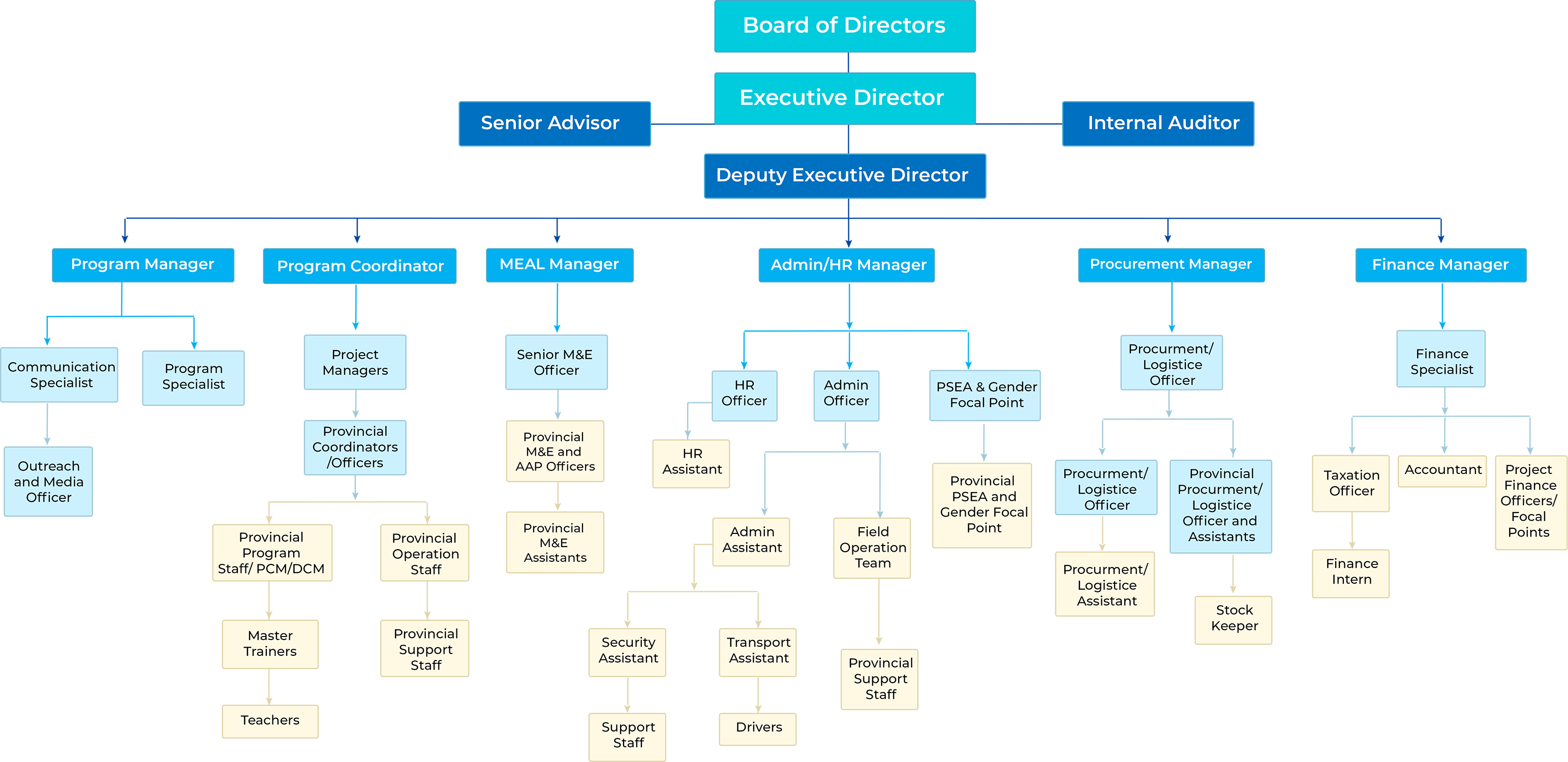
ACDO maintains a clear, accountable and decentralized organizational structure designed to support effective program management, strong internal oversight and timely decision-making across its areas of operation. The organizational chain of command establishes clear lines of authority and responsibility. Department Heads report to the Executive Director, while staff members report through their respective departmental and functional management structures. This arrangement promotes effective supervision, coordination, accountability and separation of responsibilities across program and support functions. Further details of ACDO's governance and reporting structure are presented in the organizational organogram. ACDO currently maintains a team of 496 paid staff (42.6% Female) and over 100 volunteers (Male & Female) based in Kabul and across its operational provinces. ACDO's staffing model combines technical, program, operational and field-level capacities, enabling ACDO to mobilize and manage multiple projects simultaneously across different geographic locations and sectors.
Decentralized Field Management
ACDO's operational model combines central strategic oversight with decentralized provincial implementation capacity. Each operational province is supported by a Provincial Coordinator (PC) or designated Focal Point (FP) who serves as ACDO's primary field-level management representative. Provincial Coordinators and Focal Points are responsible for coordinating program implementation, facilitating engagement with local stakeholders and communities, representing ACDO at the provincial level, supporting field teams, monitoring implementation progress and ensuring that organizational policies, program requirements and operational procedures are appropriately applied. They maintain regular coordination with Kabul-based technical and management teams, creating a structured link between field implementation and organizational leadership.
Scalable & Multi-Project Capacity
This structure enables ACDO to operate across multiple provinces and manage multiple projects and funding streams concurrently, while maintaining appropriate lines of accountability, technical support, program oversight and operational coordination. Central functions provide strategic direction, technical guidance, quality assurance, financial and administrative oversight, while provincial structures provide the local presence, contextual understanding and implementation capacity required for effective field delivery. Through this combination of centralized governance and decentralized implementation, ACDO is able to scale its operations according to program requirements while maintaining clear accountability, consistent organizational standards and responsiveness to communities and partners.